Showing posts with label Proverbs and Sayings. Show all posts

Friday, December 07, 2007

Funny Proverb

Friday, December seventh, two thousand and seven

An interesting saying made me laugh the other day. That was said by Anton Chekhov, a Russian author.

"If you are afraid of loneliness do not marry."


Haha-! Could be true. That's exactly why I often go out to get together with my friends, including young ladies and native English speakers. :p
Speaking of get-together, we are having the year-end party(bounenkai) on the fifteenth at the Japanese style bar(izakaya) managed by my second cousin in Sennan city actually. I invited some friends, including native English speakers and Japanese nice ladies to the party. :D In Japan, it's kind of tradition to have bounenkai in December in order to forget all bad things they had that year and think about happy things they will be able to have next year. That's why the kanji of "bounenkai" consists of "to forget", "year", and "party." Anyway, as of now, three Americans, two Australians, one New Zealander and one British person are coming to the party. Let me paint the town red with the crazy guys. :D


2007年12月7日(金曜日)

先日、面白い格言を見て、笑ってしまった。その格言は、ロシア人の作家アントン・チェーホフが言ったもので・・・・

『孤独が恐ろしかったら、結婚するな。』


ぎゃははははははは _(_ _)ノ彡☆ばんばん! そうかもしれない。だから、ワシって、しばしば友達と集まるために外出するんやね、もちろん、若い女性と英語のネイティヴスピーカー達と一緒に。(^_^;
集まると言えば、15日に、私のふた従兄弟が泉南市で経営している居酒屋で忘年会をする予定です。日本では、12月に忘年会をするのは、ちょっとした伝統みたいなもんです。その目的は、その年にあった悪い事全てを忘れて、新年には楽しい事があるように祈ろう、ということ。だから、『忘年会』という漢字は、『忘れる』『年』『会』という漢字で構成されているのですね。とにかく、今のところ、3人のアメリカ人、2人のオーストラリア人、ニュージーランド人1人、イギリス人1人がパーティに来てくれる予定です。面白い友人達と、大いに盛り上がろうっと!(^^♪

Monday, December 03, 2007

Level Check & Fat Pig

Saturday, December third, two thousand and seven

I took a level-check test yesterday at a new NOVA's branch, which reopened two weeks ago in front of JR Higashi Kishiwada station. Actually, I'd like to review old lessons I've taken before as a level-5 and level-4 student through real lessons, so I wanted to let my level down, from 3 to 4 or 5. That's why I took the check although I don't necessarily have to take it.
The teacher who checked my skills were an Australian teacher and used to be a teacher of mine when I belonged to old Kishiwada NOVA school. He knows my level.... It's meaningless to check my skills because he knows my real abilities very much. Plus I wasn't able to pretend like a level-4 or 5 student. X( Of course, he assessed my capabilities as high. After all I'm going to take level-3 lessons(ZONE-G) from next week.

To change the subject, a unique phrase, "fat cat", made me laugh actually. My dictionary says that it means "someone who has too much money, especially someone who is paid too much for their job - used in order to show disapproval." In Japan, they say "fat pig" as the same meaning expression. And also they say "to give cats money" or "to give pigs pearls" as "to waste assets." The former NOVA president, stupid Sahashi, was totally a fat cat or a dead duck. According to my dictionary, "a dead duck" means that a plan, idea etc that is not worth considering because it is very likely to fail. I guess the meaning sounds like useless and needless stuff. I don't know whether or not my guess is correct though.


『レベルチェックと太った豚』
2007年12月3日

昨日、新しいNOVAの支店(JR東岸和田駅前に再オープンしたところ)でレベルチェックテストを受けました。実は、実際のレッスンを通して、レベル4または5のときに受けたレッスンを復習したいんです・・・そのためにレベルを落としてもらいたかった。(3から、4または5) だから、レベルチェックを受けたのです。必ずしもレベルチェックを受ける必要はないのですが・・・
レベルチェックをしてくれた先生は、オーストラリア人の先生で、かつて私が所属していた旧NOVA岸和田校の先生でした。彼は、私のレベルを知ってるやん・・・・チェックする意味が無い・・・だって、彼は私の能力をよく知っているから。そして、私はレベル4か5の生徒の振りをすることができなかった。(>_<) もちろん、彼は私の能力を高く評価してくれたので、結局、来週からレベル3のレッスン(ZONE-G)を受ける予定。

話は変わって、面白いフレーズ"fat cat(太った猫)"を見て、笑ってしまいました。私の辞書によると、その意味は、『有り余る金を持っている、特に多すぎる給料を持っている人。不満を表すために使われる』ということらしい。日本では、『太ったブタ』が同じ意味の表現にあたります。そして、また、日本では、『猫に小判』『豚に真珠』というのは、『財産を無駄にする』という意味になります。前のNOVAの社長『アホの猿橋』は、まさに"fat cat"もしくは、"dead duck"ですね。私の辞書によれば、"dead duck"というのは、『考慮するの価値の無い計画、アイデアなど。なぜなら、おそらく失敗しそうだから。』私の推測では、役に立たないとか、不必要なモノといった意味のような感じがします。私の推測が正しいかどうかわかりませんが・・・。

Monday, November 19, 2007

Personal Connection(人脈)

Monday, November nineteenth, two thousand and seven

Some people occasionally say to me that I have quite a few personal connections and I'm an activist. However, I actually don't think so. Now that I'm a factory worker working in the countryside, I don't have many relationships related to my business. In fact, when I was a office worker, I used to have a lot of human networks compared to now. I'd like to make much of my private personal relationships against my few business networks. That's one of the reasons I often use mixi, the most famous SNS in Japan. As a result, those who know me personally may think that I'm an activist or have a lot of networks.

At one time, when I was a office worker, my senior staff said to me, "Human networks can't be bought by money, therefore, it might be the most important thing to build them up."
There is an adage(proverb) in English, that's similar to the above saying, "It's not what you know but who you know."
Exactly! I think it's true! There's no more exciting thing than meeting new interesting people in my life. Making friends with nice guys could bring me a purpose of life. For me, English language is nothing but one of the ways to meet new people.... Um... My English teachers would be mad at me to hear that. :D


2007年11月19日(月曜)

たまに、人から言われます。『あなたって、人脈が豊富ですねぇ。また、活動家ですねぇ』と。でも、そんなことはありません。今、田舎の工場労働者ですから、仕事関係の人脈は非常に少ないのです。事実、サラリーマン時代は、今よりも沢山の人脈がありました。でも、今は田舎の労働者。仕事関連の人脈が少ない分、プライベートでの人の繋がりを大切にしたいのです。私が、SNSのmixiを使っているのも、その理由の一つだと思います。その結果、私のプライベートの部分をご存知の人から見たら、『活動家』とか『人脈豊富』に見えるのかも?

昔、会社の先輩に言われたことがあります:『人脈はお金で買えない。良い人脈を構築することは、人生で最も重要なことかもしれない。』・・・と。
英語でも、次のような諺があるらしいです:"It's not what you know but who you know."(大切なのは何を知っているかではなく、誰を知っているかだ。)
まさに、その通り!!!と思います。人との出会いほど、面白いものはない。良い人との出会いは、私にとって、生きがいと言ってもいいかもしれない。英語は、そのための一つの手段に過ぎないのです。・・・こんなことを言ったら、英語の先生に怒られるかな?(笑)

Friday, November 16, 2007

To Tighten My Belt(=財布のひもを締める?)

2007年11月16日(金曜)
Friday, November sixteenth, two thousand and seven

昨日に続いて、違う英語の表現について言及してみます。(^^♪

英語で"to tighten one's belt"というと、私の辞書(ロングマン)によると、以前よりもお金を使わないようにすることを意味するそうです。この意味は、私にとって簡単に推測できます。別の辞書では、このイディオムは、飢えているときに気を紛らわすためにベルトを締めることに由来している、と書いてます。
日本語では、(非常に有名なイディオムなので、ほとんどの日本人が知っているに違いないのですが)出費を減らすときに、『財布のひもを締めよう』と言います。

余談:あかん・・・風邪ひいて、しんどい。今夜は、ヒロシさんという友人宅で、英会話喫茶のオープンについて、打ち合わせをしなくちゃいけないのに・・・どうしよう?(ToT)


Following the previous post, let me mention another English expression, kind of an idiom. :D

In English "to tighten one's belt" means to try to spend less money than someone used to, according to my dictionary, LONGMAN Dictionary of Contemporary English. The meaning is very easy for me to guess. Another dictionary says that the idioms derive from tightening your belt to take your mind off when you are starving.
In Japanese, they say "Let me tighten my purse strings" when they have to cut down on expenses, which is such a famous idiom that almost all Japanese people must know about it.

Gee..... I'm under the weather now to catch a cold. However, I have to discuss a new English cafe with my friend whose name is Hiroshi at his house tonight. How can I help myself? :(

Monday, November 12, 2007

Nine Days' Wonder(=人も噂も75日?)

2007年11月12日(月曜)
Monday, November, twelfth, two thousand and seven

日本語と英語は全く違う言語ですけど、ときどき似たような言い回しを見つけるときがあります。それは、そうです。言語は違えど、同じ人間なんですから、根底にある感覚はやはり似ているのでしょうね。
先日、"nine days' wonder"という英語の表現を目にしました。私の推測ですが、これは日本語の『人の噂も75日』に近い表現だと思います。日本では、『人の噂(話題)なんて、せいぜい75日もあれば消えてしまうもんさ』というような意味ですが、英語では『大騒ぎするのも、せいぜい9日くらいなもんさ』みたいな意味なのでしょうか?9日と75日・・・大きな差があるのは、なぜなのでしょうか?日本人のほうが、つまらないことで大騒ぎする傾向が強いからかなぁ・・・う~ん・・・そうかも。(笑)

Even though Japanese language is completely different from English, sometimes I find similar expressions between them actually. That's understandable because those people use different languages but they are the same human being, so the underlying senses would be similar, I guess.
The other day I saw an English term "nine days' wonder". The way I see it, it means similar to this Japanese one "人の噂も75日(hito no uwasa mo nana juu go nichi.)" It means rumor and popular topics will disappear within 75 days at longest in Japanese, but on the other hand, does the English one mean it will continue for 9 days at longest to make a fuss about small things? I don't know why there is a big difference, 9days and 75 days.... I suppose that Japanese people strongly tend to make a big deal about minor things. Umm... Could be. :D

Wednesday, June 20, 2007

The Happiest Person

Wednesday, June twentieth, two thousand and seven

I personally think....

The happiest person in the world is the one who believes themself is wise, although themself is the most stupid person.

The unhappiest person in the world is the one who thinks themself is stupid because of being often bothered by the happiest person, although themself is much wiser than the real stupid person.

Monday, June 04, 2007

Kill Two Birds With One Stone

Monday, June fourth, two thousand and seven

Finding interesting English proverbs is really interesting to me actually. I can learn not only English but also effective life styles through it. As everyone knows, there's a famous common saying, "kill two birds with one stone", in English. I had thought it derives from the Japanese one, 一石二鳥(isseki nicyou), for ages, so I asked an English teacher the other day if it derives from the Japanese proverb or not. He replied to me that he wasn't so sure because there are tons of common sayings among many languages.
After that, I tried to figure out the exact origin on the Internet. Against my guess, I realized in the end that the English one is probably original and it was translated into the Japanese one in Edo era or Meiji era. Besides the Japanese one was started using commonly in the country in after World War 2! Amazing! I guessed the English proverb derived from Chinese or Japanese language because of the ring.

By the way, the recent busy job is really killing me. I'm so tired I could sleep for a month...zzz

Friday, March 16, 2007

Making Lots of Mistakes

Friday, March sixteenth, two thousand and seven

Because I had a huge amount of Japanese sake tonight, my brains don't work so well that today's artcle is very short. :) I actually saw a good witty remark on the Internet, that's "The only way to avoid mistakes is to gain experience. The only way to gain experience is to make a mistake." Sounds very interesting, and it must be true! Let me make tons of mistakes in my English lessons from now on!

Anyway.... it's Friday today, so I shouted out after today's work, "Thank God, it's Friday!" Let me have some more alcohol and excellent heavy metal music over the night! I was looking forward to having such a good spare time...

Wednesday, January 10, 2007

Better to Fail in Originality

Wednesday, January tenth, two thousands and seven

I have nothing special to write down here today. But I just want to go on writing my English diary everyday as long as possible. Let me put some sentences on with the word I've studied recently.

I saw an English witty remark the other day, that's "It is better to fail in originality than to succeed in imitation." That sounds like my new year's resolution. Actually, I decided to write my English diary without so many difficult words so that I can tell anyone the contents smoothly. Let me change this remark myself.

It's better to fail in writing English sentences originally than to spend lots of time to write perfect and difficult ones.

I'm not sure that this sentence is grammatically correct, of course. :)

I'm very happy if the improvement of my English stemmed from writing English diary anyway. So I recommend that those who study English write diaries in English to get used to writing and speaking English. It might be the best way, I guess. However, don't accept what I told you without questioning it, because all my efforts might go against me. In fact, I sometime(often?) put my foot in my mouth.


It is better to fail in originality than to succeed in imitation.: 模倣して成功するよりは、独創的に失敗するほうがいい
stem from something: ~の結果である
Don't accept what I told you without questioning it.: 私が言ったことを鵜呑みにしないで
All my efforts go against me. :努力が裏目に出る。
put one's foot in one's mouth: ヘマをやる

Sunday, January 07, 2007

Omikuji, Luck is when ...

Sunday, January seventh, two thousands and seven

Let me introduce one of Japanese customs to you below.

Most Japanese people visit shinto shrines and Buddhist temples for their new year's visit, to pray for prosperity, happiness, health and something like that. And then, most of them obtain "Omikuji(s)" there, which are written oracles and tell you about your fortune of this year - such as marriage, health, business and wealth. "Omikujis" indicate your fortune from extremely good(大吉 daikichi) to extremely bad(大凶 daikyou) and suggest what to do afterwards. If the Omikuji you get indicates a good fortune, you should bring it home. But if it's a bad one, you should tie to a branch of a tree in the shrine or the temple in order not that the bad fortune doesn't annoy you after that.
Actually, I don't believe such fortunes, that's why I rarely obtain Omikujis. Plus if I get a bad one, I'll positively think I'm so lucky. Because there tend to be few bad ones in Omikuji boxes, so getting a bad Omikuji is sort of a proof that I'm a lucky person. :) And also I don't like most fortune tellers, especially I dislike Kazuko Hosogi, who is a very famous female fortune teller in Japan and often appears on TV. In spite of she has got divorced before, she often tells TV personalities about their fortune strongly and aggressively as if she knows all about the ins and outs of them. I am sick and tired of seeing her face on TV.

Anyway, luck is what happens when preparation meets opportunity, as a witty remark(famous saying, maxim) says. I saw this interesting English remark on an email newsletter the other day, actually. This saying sounds similar to a Japanese common saying, "運も実力のうち Un mo jitsuryoku no uchi.", which maybe means that luck is included in your ability in Japanese.


as if : あたかも~のように
ins and outs of something: ~の一部始終(直訳:内側も外側も)
be sick and tired of something: ~には、もううんざりだ
witty remark(famous saying, maxim): 名言

Sunday, November 26, 2006

Event and Phrases

Sunday, November twenty sixth, two thousands and six

My wife asked me to take two of our kids somewhere to make our eldest son concentrate on his study this afternoon. Actually, he has to take the final exam(term-end examination) that is going to be carried out next week. When it comes to our children's tests, my wife become the most education-minded mother on the planet. :-p

Anyway I had to take them somewhere, so I went see the International exchange event, that is held in Rinku Town, a town which is very close to Kansai international airport, at this time of the year, with my third son and daughter. Plus we got together with an Australian friend of mine there. There were so many foreigners in the event place that I had to speak a hundred languages. :)

After I got back home, I saw a couple of interesting English phrases on the email newsletters that I often read on my cell phone. Let me introduce them to you.

Keep your eyes wide open before marriage, and half shut afterward.

Marriage halves our griefs, doubles our joys, and quadruples our expenses.


Very funny! But exactly true! Sounds fascinating! I'm so curious about such interesting and useful English phrases, actually. As for me, I'm often said "Act your age! You're more trouble than a child!" over and over again by my master, who is what is called my wife..... haha.


concentrate on something: ~に集中する
when it comes to something: ~のこととなると、
at this time of the year: 毎年この時期に
afterward: [adverb]後で
halve one's grief(s) : 苦悩を半分にする
quadruple one's expense(s): 出費を4倍にする
fascinating: とても面白い、興味をそそる
be curious about something: ~について知りたがっている
As for me ....: 私といえば...
Act your age.: 歳相応の振る舞いをしなさい!
be more trouble than a child: 子供より手がかかる
over and over again = many times(???)
what is called something: いわゆる~

Tuesday, September 19, 2006

Return to Analog

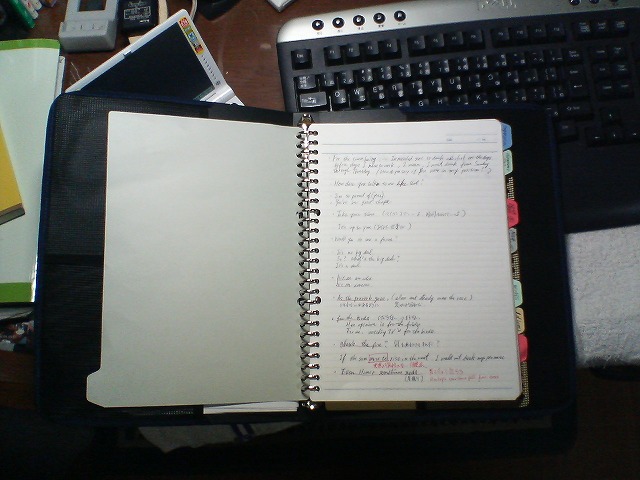
loose-leafI've just decided to write down "review of lessons", "collection of words and phrases", "collection of expressions", and "collection of idioms" in an ANALOG METHOD. I mean, I'll write them down by hand in a notebook. Of course I have to type English sentences when I send emails and post articles on my blog, though.

I bought a loose-leaf notebook the day before yesterday after a long interval, which I often use in my school days. Let me write down a massive amount of contents in the notebook from now on!

I've just realized my writing is worse in both English and Japanese than it used to be after I wrote down some sentences by hand after a long time. Besides, I can't write down some Chinese characters(kanji) so I have to use Japanese dictionary.... haha. However, it's also a good way for studying Chinese character to write down sentences by hand.

Yeah! That's a way of "Killing two birds with one stone."
I'm so lucky! :)

What? You ask me, "Why have you decided to return to the analog method?", don't you? Actually, I feel I can't memorize any words and phrases by typing them into my PC. It's convenient if all contents are in my PC when I want to search them out, though. In addition, I sometimes see a nice guy in my English school who often write down many sentences in a notebook and looks so cool, so I want to copy the person. :)

I would be happy if I could build up my supreme notebook. Anyway, as the proverb goes, slow and steady wins the race. - In Japanese, 急がば回れ isogaba maware.

| |

Friday, September 15, 2006

As, as, as! and a paper tiger

I feel I'm still a low level English learner once in a while... no, no... very often. :)
To tell the truth, I'm often confused about the usage of articles(a, the, no-articles) and which I should choose, the singular form or the plural form. Besides the usage of the word "as" is very difficult for me because it has so many meanings and the part of speech often changes - such as adjective, adverb, and conjunction. However, I may as well tell myself that I don't have to care about those things. If the sun were to rise in the west, I wouldn't become a native English speaker. :)

Anyway, I'm extremely busy this month and next month because of so many festivals!

For instance:
The sports day(Field day, PE festival) in my daughter's kindergarten(preschool)
The sports day(Field day, PE festival) in my third son's elementary school(primary school)
The sports day(Field day, PE festival) in my eldest son's junior high school
The yagura festival in my city - a kind of harvest festival

They are killing me! But I'm a little bit lucky since my job doesn't wear me out as of now.

By the way, let me write down an interesting expression I found out on the Internet or somewhere recently.

A paper tiger:
According to my dictionary, it means that an enemy or opponent who seems powerful but actually is not. Sounds interesting! In Japan, we have the similar expression, which is "張子の虎(はりこのとら hariko no tora). hariko is sort of a doll made from paper. I also found out the similar one, which is "have no teeth". Apparently the meaning is the same as "a paper tiger".

Sunday, September 03, 2006

Educated Mother

Misaki park2This morning my wife asked me to take our third son and daughter somewhere so that our eldest son could get down to his study and she could look after him. She orders me anything as if she were a teacher of mine anytime she gets our children to study.

Anyway, I took them to a small amusement park in the southern part of Osaka prefecture, whose name is Misaki Park, while our eldest son was studying for the test which he's taking next week. I don't know why most Japanese women tend to be education-minded mothers. :(
Misaki park1On the other hand, we had a good time in the park today :) - such as dolphin show and seeing lots of animals, but we should have prepared swimming wear. Because I noticed that the swimming pool in the park had opened until today when I arrived there.

Speaking of education-minded mother, I saw an interesting English sentence on the Internet the other day, which is how to remember the order of our solar system.
That phrase is "My Very Educated Mother Just Serves Us Nine Pizzas." This is a mnemonic for the order of our solar system(Mercury, Venus, Earth, Mars, Jupiter, Saturn, Uranus, Neptune, and Pluto), according to some web sites. Now that Pluto, only one found by American, however, has deleted from the system, so there are eight planets in it as of today. Needless to say, this phrase is needed to change right now - for instance, "My Very Educated Mother Just Serves Us Noodle.", which is actually said by an English teacher of mine this past Saturday. (^_^;)

Here are some videos of the dolphin show I took in the park.


Friday, July 14, 2006

Persistence pays off

July 14th, 2006

I restarted studying English last April, so one year and a few months passed already. Some teachers sometimes tell me my skills become much better. I'm so glad to hear that, of course. But that might be kind of flattery(お世辞 oseji). Can I say "Flattery will get you nowhere." ? Anyway, I received the compliments directly at that time. :)

And now, I'd like to introduce a Japanese proverb today. It's "継続は力なり(keizoku wa chikara nali)", literally translating to "Continuation is power." According to some web sites, it means in English like this - "Persistence pays off. So don't give up. Just keep trying."
I'm already on the wrong side of 40; however, I'll keep going as much as possible.

By the way, I don't understand why the phrase "on the wrong side of" means "over". I'll ask my teacher the question tomorrow...

P.S.
Let me indicate new words in bold letters from now on, which I'd like to memorize.

| |

Saturday, July 01, 2006

Nothing but good score

July 1st, 2006

I read an interesting English phrase on an email newsletter, which introduces a witty remark(witticism, maxim, or famous saying?) of the world every day.
It was "A business that makes nothing but money is a poor kind of business.", said by Henry Ford, who is the founder of a big car company in the USA as you know.

The phrase means that a company doesn't exist only to make money. Sounds great! It's typical of him, I think. After reading the phrase, I came up with an English phrase right away.
It was "A study that makes nothing but a good score is a poor kind of study." Most of studies should be useful in the future, not to make a good score at school or other places, I suppose. But my wife often told our children to study hard in order to make a good score. Why are mothers nervous about the scores which their children make? In fact, most Japanese mothers tend to be education-minded mothers. It' called "教育ママ(きょういくまま Kyouiku mama)" in Japanese. :)

| |

Tuesday, June 20, 2006

There's always somebody above you.

June 20th, 2006

I went for a drink to "Murphy's Irish Pub" and "Cinquecento" with two
ladies last Saturday night. They are the nicest ladies I've ever seen! haha. Just kidding. :)
Actually, they are some of study buddies(pals) at the English school which we often take lessons.

Before going get a drink, we took some free conversation classes at a big branch of the English school. There were some high level students in the room then. I could catch the many of what they and some teachers said, but couldn't talk a lot. I got a terrible headache, plus so embarrassed I wanted to die. (ToT) Some of them can speak English fluently as native English speakers, and one of them can speak 4 foreign languages - such as Arabic, German. Amazing! So, I visualized the Japanese proverb, "上には上がいる(ue niwa ue ga iru)", it means "There's always somebody above you." in English, maybe. The proverb warns that it's never enough to look up(stare up?) and that you shouldn't brag about your skills too much if you think yourself that you're one of the best person. But I've just decided to study English harder from now on! Much harder? No, a little bit harder..... hehe. Anyhow, it makes me motivate that there are so many high level students in the English school .

By the way, They told me that it was OK for them to go get a drink with me because they never get nervous with middle-aged men and would get nervous if I were a young man. Should I be happy or sad???
I wanted to post the photo which was taken in the bar, but I can't do that. Because two ladies show up on the photo, which is kind of their personal information, and I didn't get their permission to post it on my blog. That's why I can't post it on this page.

Anyway, I'm so lucky to get acquainted with such a nice ladies! I appreciate your going for a drink with like of me, Misses!

| |

Saturday, April 08, 2006

Fever

April 8, 2006

My new nice, the second daughter of my younger brother, had a fever at the night of the day before yesterday. Her mother(my sister-in-law) took her to a hospital yesterday. The doctor said that she didn't seem to have any serious problems but needed to enter the hospital for a couple of days just in case. So my younger brother had to prepare for the hospitalization yesterday. We decided not to work overtime and not to work today(Saturday, on our day off) even though we are extremely busy. "There is no choice."
I've just heard of her condition. The result of checkup she took last night wasn't so bad. She'll be fine soon, the doctor said. I'm so relieved to hear that. On the other hand, I can take a day off on Saturday after a long time. It sounds like "災い転じて福となす(わざわい・てんじて・ふく・となす)" that means "to turn the potential disaster to one's advantage".

| |

Tuesday, March 28, 2006

Narau yori narero, go nuts

March 28, 2006

Let me introduce a Japanese proverb to you. (I'm not sure who "you" are. haha)

習うより、慣れろ(ならうより、なれろ Narau yori narero.)

According to my dictionary, the English word of the Japanese proverb is "Custom makes all things easy." or "Practice makes perfect." Sounds cool ! I can't make such nice phrases due to my poor skill. :-<
If I make the phrase for the proverb, I'll do like this - "It's more important for your study to get used to the stuff(thing ? theme ? issue ?) than to learn it." Hm.... Only easy words. I've just felt certain that I have to learn English so hard.... Ooops ! No, no ! It's more important to get used to English as I've just written down....

By the way, I've ever seen an English idiom "go nuts" in an email magazine. I guess it's a little dirty slang word, right ? However, let me wite a composition with the word.

If I fail in the test which I'm going to take next Sunday in order to be a level 4 student at an English school, I bet I go nuts !

| |

Wednesday, February 15, 2006

Wrinkles

February 15, 2006

There are no wrinkles on (the surface of) one's brains.
(脳みそにしわが無い。)
(のうみそにしわがない。Noumiso ni siwa ga nai.)

Do you understand what I mean ? It's a Japanese common saying and means "stupid." It's similar to the slang word, "airhead", I think. Sorry to post such a filthy(rude or dirty) slang word. :-)
In Japan, it's said that the wrinkles on brains make people smart and clever. So if there were no wrinkles on someone's brains, the person would be unsmart. Of course there never are such people, though. :-p

I actually heard from a Japanese female student on the last English free conversation class that she's always worried about her crow's feet(the wrinkles/lines/creases at the outer corners of her eyes) though she's so young. I came up with the idea of posting this article then.